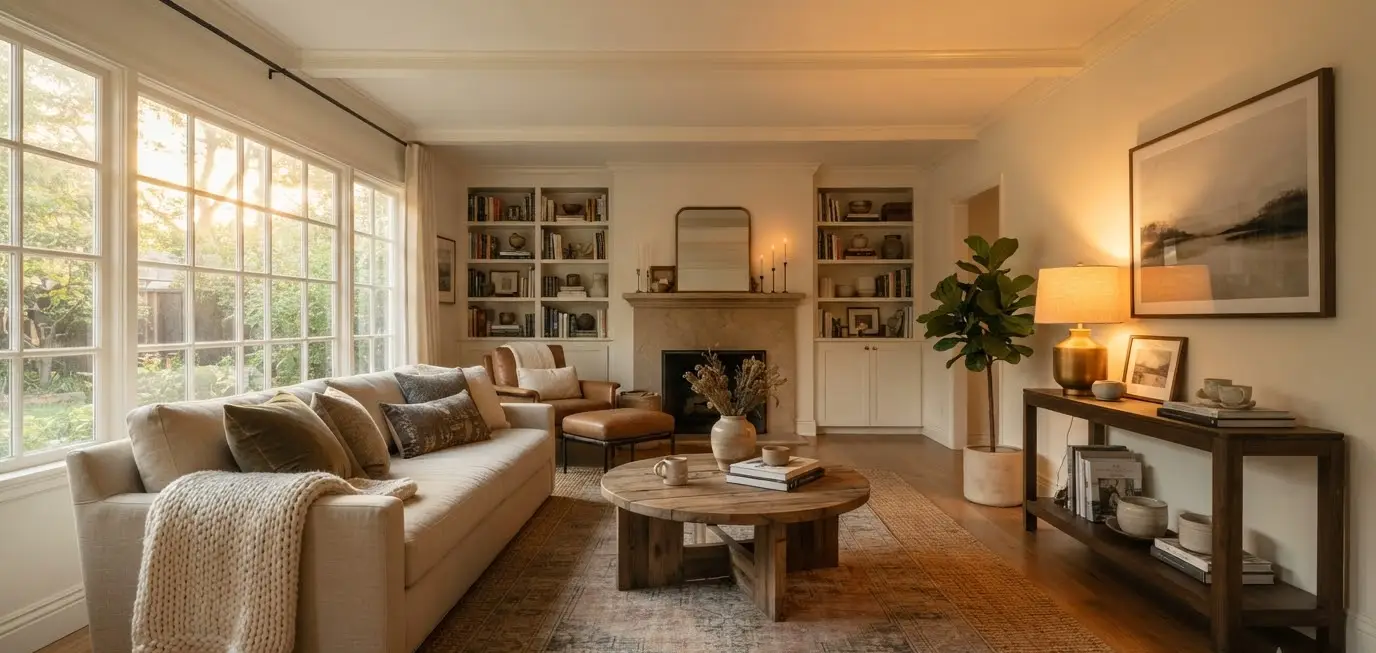
I redid my living room three times before it actually felt like a place I wanted to sit in. Not “looked nice in photos.” Felt right.
There’s a difference, and most people chase the wrong one first.
If you’ve been pinning a hundred living room boards and still feel like your space is missing something, you’re not alone.
Cozy isn’t a color palette. It’s a set of small, deliberate choices that add up. Let’s get into what actually works.
I grew up in a house where the living room was basically off-limits, all plastic-covered furniture and “don’t touch that.” So when I got my first apartment, I overcorrected hard toward the opposite.
Every idea below came from actual trial and error, not a design textbook.
Some of them worked immediately. A few flopped completely, and I’ll be honest about which ones.
What actually makes a living room feel cozy?

Cozy is layers, texture, warmth, and a little bit of mess in the right places. A pristine, magazine-perfect room can feel cold even with a fireplace roaring in it.
IMO, the rooms that pull you in have a lived-in quality: a blanket tossed just so, a candle burning, a lamp instead of a harsh overhead light.
Here’s a quick breakdown of the core elements and why they matter:
| Element | What it does | Common mistake |
|---|---|---|
| Lighting | Sets mood instantly | Relying only on ceiling lights |
| Texture | Adds warmth you can feel | Sticking to one fabric type |
| Layout | Encourages conversation | Pushing all furniture against walls |
| Color | Grounds the whole room | Going too stark or too busy |
Once you understand those four, everything else on this list slots into place.
There’s also a psychological piece to this that people skip over.
A room that feels cozy usually gives you multiple small “zones” to choose from, a reading corner, a spot near the window, a place to curl up with a blanket.
A single big open space with one sofa facing a TV doesn’t give your brain the same options, and that lack of choice can make even a nicely decorated room feel oddly unwelcoming.
Lighting ideas that change the whole mood
1. Swap your overhead light for lamps

Overhead lighting is the enemy of cozy. It’s flat, it’s harsh, and it makes every room feel like a waiting room. Bring in two or three table lamps at different heights instead.
2. Go warm, not white

Choose bulbs around 2700K. Cool white bulbs make a room feel clinical, and nobody wants their living room to feel like a dentist’s office.
3. Add candles, real or flameless

I keep a mix of both. Real candles for evenings I’m actually home to watch them, flameless for when I forget I lit something (which happens more than I’d like to admit).
4. Try string lights on a shelf or mantel

This sounds like a college dorm move until you see it done right.
Warm-toned fairy lights tucked behind books or draped along a mantel add a soft glow that regular lamps can’t replicate.
The trick is restraint. One string, tucked mostly out of sight so you see the glow rather than the actual wire, reads as intentional.
Wrap the whole shelf in lights and it swings right back into dorm-room territory.
Lighting on a dimmer, if you can swing it
If your budget allows for one upgrade, a plug-in dimmer switch for your main lamp is worth it.
Being able to dial the brightness down for movie night versus up for reading makes the same room feel like two different spaces depending on the hour.
Texture and textiles: the real secret
5. Layer at least three textures

Think wool throw, linen cushions, a leather or velvet chair. Ever notice how a room with only smooth surfaces feels a bit sterile? Texture is what your hand wants to touch, and your eye follows.
My first apartment had a glass coffee table, a leather sofa, and nothing else. It looked like a furniture showroom, not a home.
Adding a woven basket for blankets and a couple of textured cushions fixed it within a weekend, no new furniture required.
6. Get a chunky knit throw blanket

Not the thin decorative kind that lives folded and untouched. A genuinely thick, oversized throw you’ll actually use on a Tuesday night watching TV.
7. Layer your rug

A jute or sisal rug as a base, then a smaller patterned or plush rug on top.
This trick, borrowed from interior stylists, adds depth that a single flat rug just can’t give you.
8. Mix cushion sizes and fabrics

Don’t buy a matching four-pack and call it done. Combine a bouclé cushion, a linen one, maybe a small velvet lumbar pillow. Variety reads as intentional, not chaotic.
9. Add a floor pouf or ottoman

Great for extra seating, a footrest, or a spot to plant your coffee mug. Practical and it softens the geometry of a room full of straight-edged furniture.
Color choices that actually warm things up
10. Choose warm neutrals over stark white

Think warm beige, greige, or soft terracotta rather than bright white walls.
According to Sherwin-Williams, warmer undertones photograph better in natural light and feel more inviting year-round, and honestly, I agree after painting my own place twice.
11. Add one deep, moody accent color

A dark green bookshelf, a burgundy accent chair, navy curtains. One saturated color anchors a room full of neutrals and stops it from feeling flat.
12. Bring in wood tones

Wood does more heavy lifting than people give it credit for.
A wood coffee table, wood picture frames, even a wood-look laminate floor instantly softens a room compared to glass and metal everywhere.
Here’s a small comparison that stuck with me: two nearly identical rooms, one with a black metal coffee table, one with a light oak version.
The oak room photographed warmer every single time, even under the same lighting. Small swap, noticeably different result.
Layout tricks nobody talks about enough
13. Float your furniture away from the walls

Pushing every sofa and chair against the perimeter makes a room feel like a waiting area. Pull pieces in a few inches and angle them toward each other instead.
14. Create a conversation circle

Arrange seating so people actually face each other. This one small change made my living room feel twice as social, and guests started staying longer, which I guess says something.
15. Define zones in an open-plan space

If your living room bleeds into your kitchen or dining area, a rug or a console table behind the sofa can visually separate “living room” from “everything else.”
I tried skipping this step once in a studio apartment and regretted it.
Without a rug or table marking the boundary, guests genuinely couldn’t tell where “living room” ended and “kitchen” began, and the whole space felt like one long hallway instead of a home.
Quick aside: my cat has strong opinions about furniture placement and will sit directly in the spot I’ve just decided looks best empty. Anyway, back to the list.
Personal touches that make it feel like your room
16. Display things that actually mean something

Skip the generic “Live Laugh Love” sign. A shelf of books you’ve actually read, travel souvenirs, or family photos does more for warmth than anything store-bought.
17. Add plants, real or good fakes

Greenery softens hard edges and adds life to a room.
A fiddle leaf fig in the corner or a trailing pothos on a shelf works wonders, and if you kill plants like I do, high-quality faux ones are honestly fine.
18. Bring in a gallery wall

A curated mix of art, mirrors, and photos above your sofa gives the eye somewhere to land.
Just keep frame colors somewhat consistent so it doesn’t turn into visual noise.
I went too wild with mine at first, six different frame finishes, three different sizes, zero plan. It looked like a garage sale on the wall.
Sticking to two frame colors and a loose grid fixed it fast, and now it’s genuinely my favorite corner of the apartment.
Small details that pull it all together
19. Add a scent

A candle or reed diffuser in something warm, like sandalwood or amber, ties the whole sensory experience together.
This is the detail people notice without knowing why they noticed it.
20. Curate a soft soundtrack

A cozy room isn’t just visual. Keep a playlist of low-fi or acoustic tracks ready for when you want the space to feel calm instead of quiet-in-an-unsettling-way.
This is the one people forget most. A room can look perfect and still feel a little off if the only sound in it is a fridge humming down the hall.
Even background music at low volume changes how long people linger on your sofa.
For more layout inspiration, Apartment Therapy has some genuinely useful small-space living room breakdowns, and The Spruce is solid for seasonal styling swaps if you like refreshing your space a few times a year.

A few honest opinions before you start pinning
Not every idea on this list belongs in every room, and IMO that’s the whole point.
A tiny apartment living room doesn’t need a floor pouf and an ottoman and a floating layout.
Pick the two or three ideas that solve your actual problem, whether that’s bad lighting, a flat color scheme, or furniture jammed against the walls.
Wow, writing all this out actually makes me want to rearrange my own living room again. Third time might finally be the charm.
FAQs
How much does it cost to make a living room cozy? You can do a lot with under $150. A few throw pillows, a warm-bulb lamp, and a throw blanket cover most of the sensory basics without touching furniture.
What’s the fastest way to make a room feel cozy? Swap your lighting first. Turning off the overhead light and switching to warm lamps changes the mood of a room in about five minutes, no shopping required.
Do small living rooms need different cozy tricks than big ones? Kind of. Small rooms benefit more from layered lighting and one bold accent color, while larger rooms need the conversation-circle layout trick to avoid feeling empty.
Final thought
A cozy living room isn’t something you buy in one trip to a home store. It’s built layer by layer, mistake by mistake, until the room finally feels like you.
So which of these 20 ideas are you trying first, the lighting swap or the furniture float? Save this for later and let me know how it turns out.




3 thoughts on “How to Create a Cozy Living Room: 20 Inspiration Ideas You Need to Try”